Continuing “The Brookside Story”

Why is Brookside such a desirable, classic neighborhood?  Read these sentences below, from LaDene Morton’s book, “The Brookside Story”:

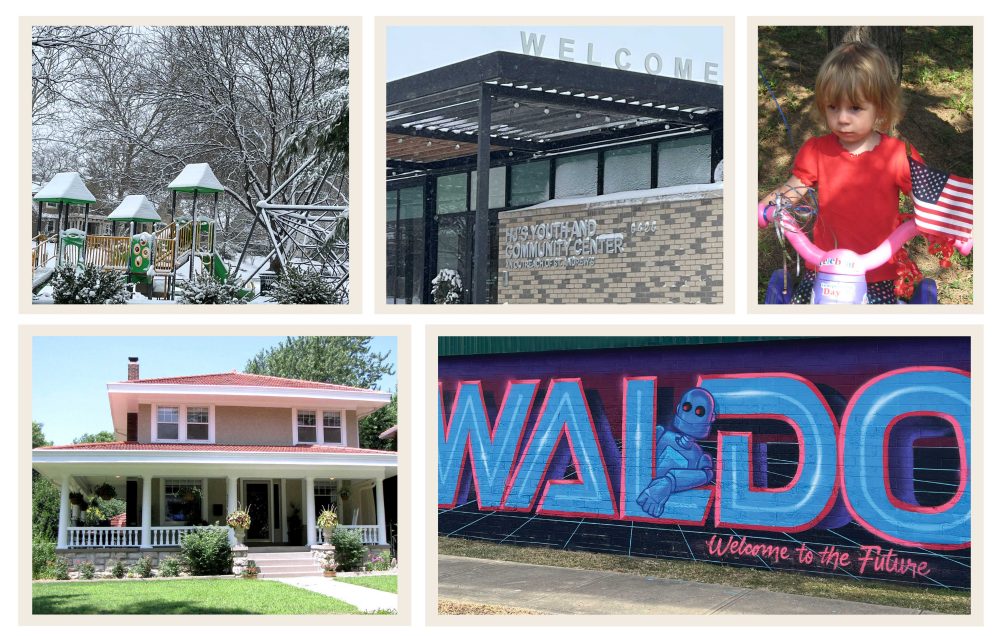
To be a child in the neighborhoods around the Brookside Shops after 1950 would be akin to living around the corner from paradise.  On a Saturday afternoon, kids could ride their bikes into Brookside and fill their entire day with childhood adventures.

She goes on to talk about The Brookside (movie) Theater, the Velvet Freeze, Katz Drugs and the Brookside Record Shop..these places and many more could entertain kids for hours on a weekend afternoon.

Those specific spots are gone now, but children (and adults) can still ride their bikes to Brookside and spend the day exploring.  My daughters do–they shop at Beauty Express, Stuff, World’s Window, The Dime Store, Baskin Robbin’s.  During the warmer months, we’ll walk down with neighbors to The Roasterie for coffee and smoothies.  It’s this walkability and sense of a close, local community that keeps Brookside thriving.

At one point there was a proposed freeway through the Country Club District.  In 1959, Kansas City started to condemn the streetcar right-of-way to plan the highway–from 85th north to Westport.  This six lane, non access highway would have cut through the heart of the district, starting and Oak and continuing west past Wornall.  Homeowners in the area close to the Trolley line rebelled, citing the inevitable loss of value in their homes.  Outrage grew among the residents, who retained several lawyers and threatened litigation.  Eventually in 1965, a Jackson County court dismissed the case, citing the City could not condemn the line. What eventually happened was the construction of the Bruce R Watkins Drive (Missouri 71 Highway) to the east.

What a nightmare that would have been, a highway cutting into the heart of Brookside!  It hurts to even think about it.  Nothing would ever happen like that now–once again, the local shopowners and residents would rise up in protest.  I think there are similarities to this situation and  the proposed new Posinelli building on the Country Club Plaza.  Unfortunately, the Plaza is no longer under local ownership and the building will probably get built, despite the continuing protests from persons all over the world.

Thanks for reading my blog, your comments are welcome!  You can reach me at mary.hutchison@prukc.com
Continuing “The Brookside Story” – Notes on Neighborhoods

Still reading LaDene Morton’s recent book “The Brookside Story” , and today I’ll write a few words about the Morningside Park subdivision and the various architecture styles found here. It’s so interesting to read a few pages..then go out and actually drive the areas she writes about.  Knowing more about the history of my neighborhood makes me appreciate it so much more.

Brookside had its beginnings in the early 1920s, and JC Nichols recognized the importance of the automobile.  He designed Brookside to be car-friendly…which is ironic, as today so many people want to live in Brookside specifically because it’s such a walkable community!  Nichols published a brochure, “A Scenic Route Through the Country Club District” for “pleasure driving” . This map is found in the book, and  takes you through Brookside, Mission Hills and the Plaza. One interesting note, at the top of the map is a headline:  200 ACRES RESTRICTED, which I assume means the area was for whites only.  The book doesn’t address the headline.

As Nichols was plotting the home sites, he created various  middle, upper-middle and high income housing but in a subtle way:  the larger, more expensive homes are to the west, and the homes gradually change as you go east.  The houses and lot sizes are different, but the exterior attractiveness of the homes are similar–there are no very sharp divisions.  To this day, home values are determined not only by lot and house size, but how far east or west of Main the home is located.  This plan ensured a variety of middle and upper income bracket residents for the area. 

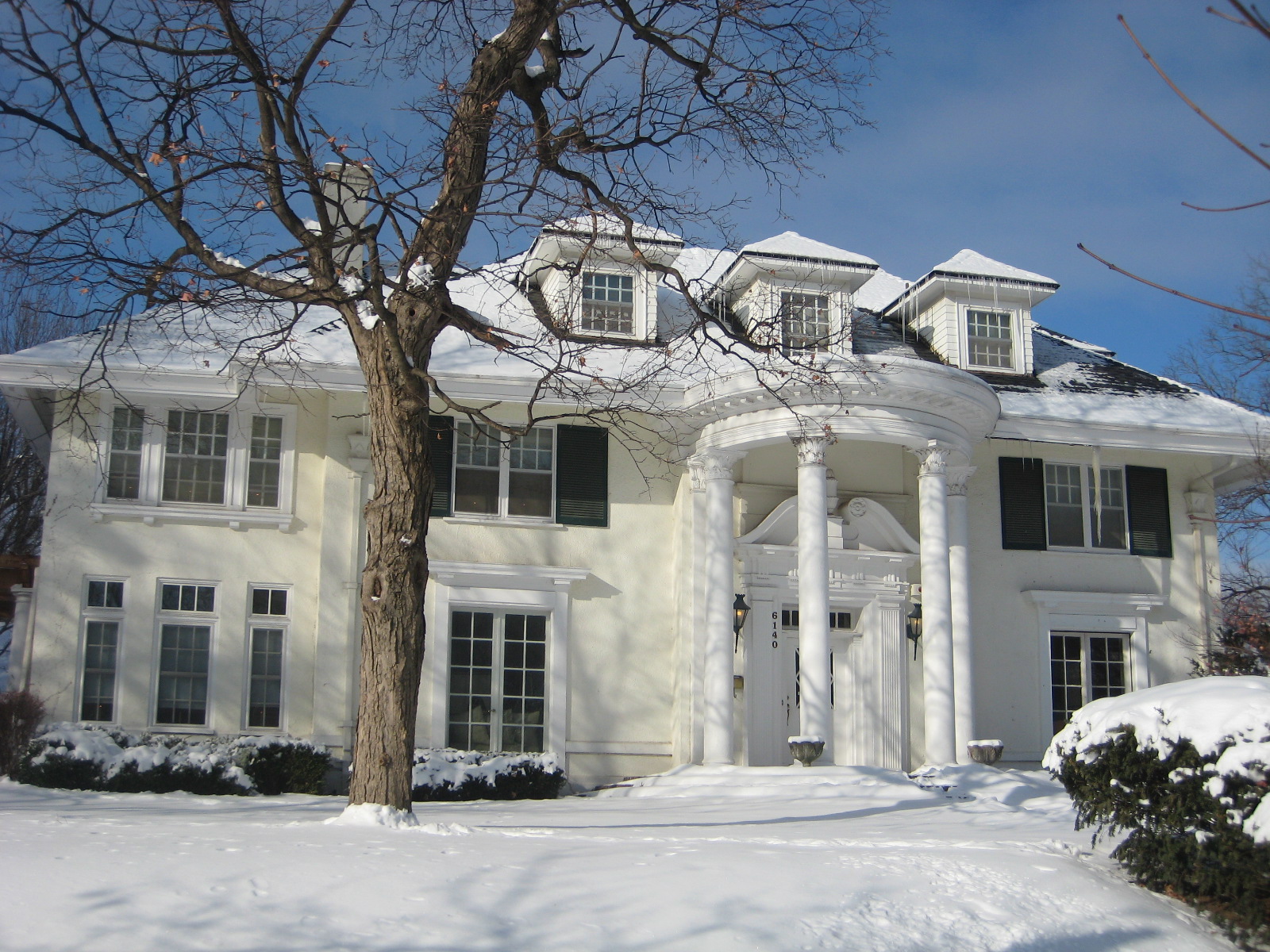
Another residential developer for the area was Fletcher Cowhert, a colleague of Nichol’s. Although much older than JC, he too had travelled extensively in Europe and was impressed with how cities were planned there.  Fletcher created one of my favorite subdivisions in Brookside, Morningside Park.  General boundaries are 59th to 62 Streets, west of Oak and east of Brookside Boulevard.  The most  prestigious address in this area is on Morningside Drive–a wide street of larger homes and lots.  The homes surrounding Morningside Drive are still beautiful, but a bit more modest. Fletcher built 6140 Morningside Drive, a magnificent home,  for his son, Fletcher Jr

6140 Morningside Drive

There is a brochure cited in the Morton’s book, “Coherd Built Homes” that Fletcher developed to sell the subdivision.  It’s motto was ” The Standard of Value” and featured photos of the finished homes.  Inside, you can read this copy:  “The high degree of beauty and permanence in Coherd Built Homes has been and will be steadfastly maintained” .  Still true today–this is one of the prettiest areas of Brookside.

Next up in the book–details on retail development in Brookside through the years.  The photos are fascinating and oh so nostalgic.  I’m heading to the Kansas City Library next week to copy some of these photos for myself–they will be great wall decor in my house!

Thanks for reading my blog, your comments are welcome!  You can reach me directly at mary.hutchison@prukc.com or my website, www.maryhutchison.org